Someone asked me:
If all your sub-agents and tools work sequentially, why do you even need Agentic AI?
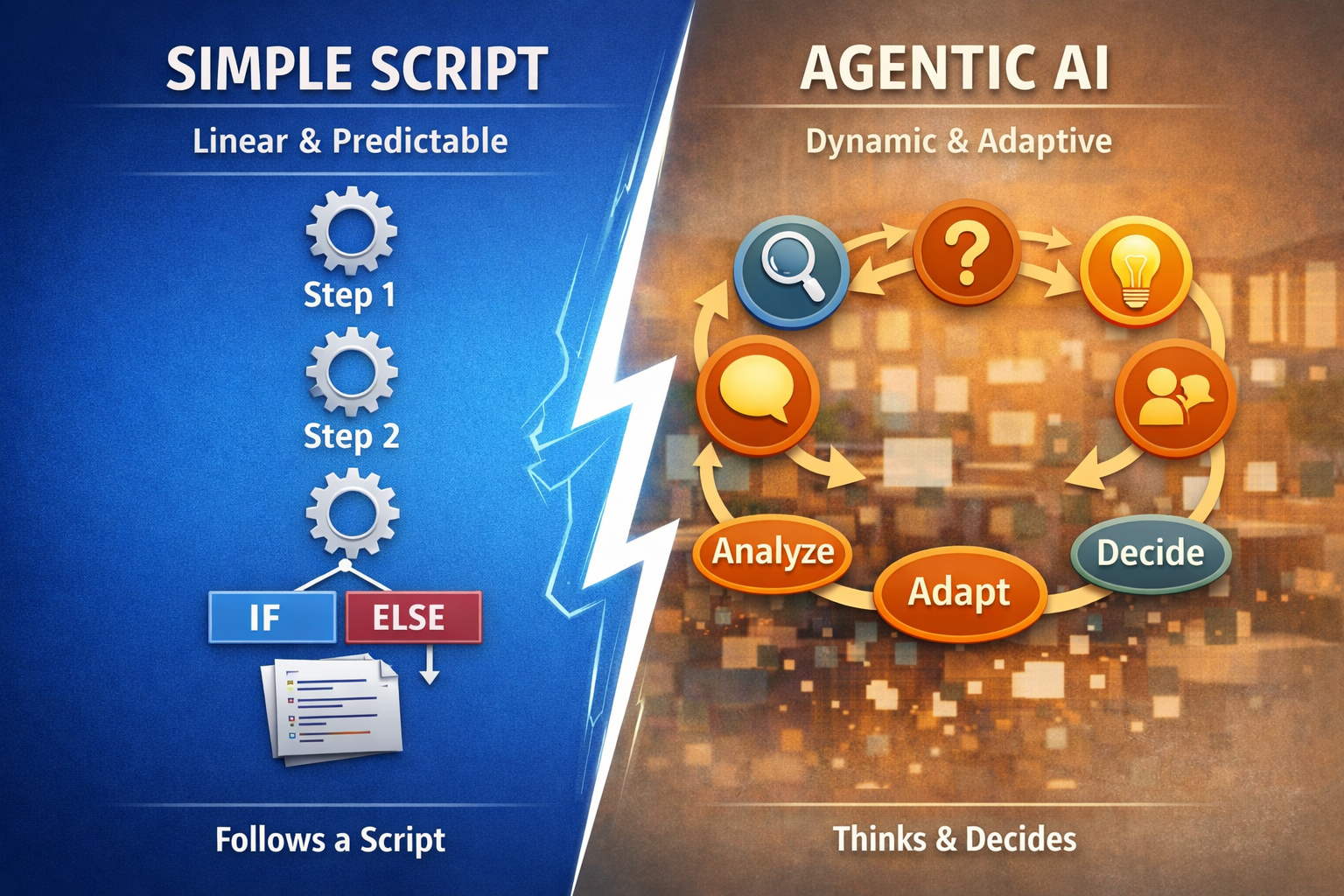
Because Agentic AI is not just tool calling. It is decision-making.
If the decision logic is simple and can be handled with a few if-else conditions, then yes, an agentic setup may be overkill. A well-written script can do the job just fine. Not every workflow needs an orchestra when a solo guitarist will do.
But when the decision graph becomes complex, dynamic, and non-deterministic, Agentic AI starts making real sense.
When a Script Is Enough
I built a defect impact analysis solution that did not need an agentic approach.
The flow was straightforward:
- Read the defect ID
- Fetch the details
- Analyze the codebase with the help of Codex
- Generate the report
Clean, linear, predictable.
That is exactly the kind of workflow where a script is the right tool.
When Agentic AI Becomes Useful
I am also working on a local knowledge research tool. I cannot share the details yet, but this one is different.
It involves multiple steps, and at each step the response has to be analyzed from a human angle before deciding what should happen next.
In that case, the orchestrator is not just passing control from one tool to another. It is:
- Interpreting context
- Evaluating outcomes
- Deciding how the next sequential agent should behave
That is where Agentic AI becomes valuable.
Sequential Can Still Be Agentic
So yes, your tools and sub-agents can still be sequential.
What makes the system agentic is not whether the steps are parallel or sequential. It is whether the system has to think before choosing the next step.